


Masseter Treatment for Teeth Grinding (Bruxism)
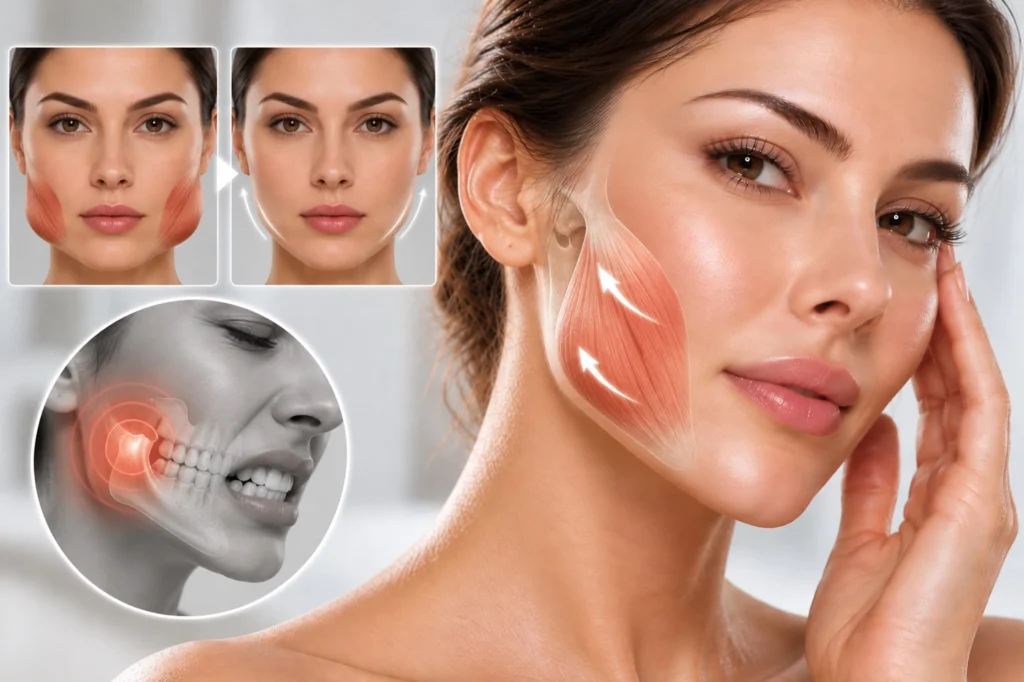
The lower third of the face largely determines the balance of the overall appearance. A wide, square jawline can make the face look broader, angular, and harsh, even if all other facial features are balanced. Masseter botox is a non-surgical medical aesthetic procedure that softens this appearance caused by the overdevelopment of the chewing muscle through injections. At our Kadıköy clinic, masseter botox is applied both for aesthetic purposes to create a more oval jawline and to reduce complaints related to teeth grinding.
What is Masseter Botox?
Masseter botox, also known colloquially as jaw botox, is a non-surgical treatment involving the injection of botulinum toxin into the masseter muscle. Also searched for under different spellings such as masseter botox or masseter botox, this procedure temporarily reduces the excessive activity of the muscle, providing both aesthetic and functional benefits. As the muscle relaxes, it gradually loses volume, leading to a slimmer and more oval jawline appearance. Additionally, in individuals who habitually clench or grind their teeth, the excessive muscle tension caused by this behavior is reduced. For this reason, masseter botox is a common treatment option for patients who say “I want to slim my jaw” and those who say “my jaw hurts due to teeth grinding”.What is the Masseter Muscle, and Why Does it Enlarge?
The masseter muscle is one of the strongest muscles responsible for chewing, located on both sides of the lower jaw. It is continuously active during daily functions such as chewing food, speaking, and swallowing. In some individuals, this muscle is genetically more developed, while in others, enlargement occurs over time for various reasons. The most common cause of masseter muscle enlargement is bruxism, an unconscious habit of teeth grinding and clenching. Factors like stress, irregular sleep patterns, or temporomandibular joint problems can trigger this habit. Habits such as constant chewing of gum or frequent consumption of hard foods can also contribute to an increase in the muscle's volume over time. Muscle enlargement can lead to widening of the lower face and, in some patients, cause jaw pain, headaches, and fatigue in the chewing muscles.How Does Masseter Botox Slim the Jaw? How is the V-Line Effect Achieved?
Masseter botox works by temporarily blocking the excessive contraction signals to the muscle. Since the muscle receives fewer nerve stimuli, it contracts less and gradually atrophies, leading to a reduction in its volume. This process is not immediate; muscle slimming occurs progressively over weeks. Noticeable thinning typically begins to appear around 3-4 weeks after the procedure, with the final and most ideal appearance settling within 2-3 months. Thanks to this gradual process, the results appear very natural; people around you notice a subtle slimming and elegance in your face but cannot precisely identify the cause. This narrowing of the lower face creates an oval, balanced facial line that tapers toward the chin, popularly known as the “V-line”. For patients bothered by a square jaw appearance, masseter botox is the most practical and non-surgical method to achieve this goal.Who is Masseter Botox Suitable For?
The most common candidates for masseter botox are those who want an aesthetically slimmer jawline, are bothered by a square or bulky facial appearance, or have genetic or acquired masseter muscle enlargement. Additionally, individuals with habits of teeth clenching or grinding (bruxism) who suffer from jaw pain, headaches, or fatigue in chewing muscles may also benefit from this treatment; botox can help reduce the severity of these symptoms. It is not applied during pregnancy or breastfeeding, in individuals with neuromuscular diseases, or those with a known allergy to botulinum toxin. The general rule is to have reached the age of 18; however, in severe bruxism cases, earlier evaluation may be considered with physician and family approval to protect dental health. There is no upper age limit; in older ages, since relative masseter muscle size can make the face appear more tired due to jawline sagging, it is also frequently preferred in this age group.How is Masseter Botox Applied?
During the examination, the jaw structure, masseter muscle size, and patient expectations are evaluated to plan the dose and injection points. The procedure usually does not require anesthesia; thin needles are used, ensuring high comfort. Multiple small injections are administered into different points of both masseter muscles. The entire procedure takes about 10-15 minutes, allowing immediate return to daily life. Mild tenderness may occur in the treated area afterward, lasting only a few hours. A slight fatigue sensation may be felt during chewing hard foods for the first few days; this is part of the muscle adapting to the new condition.Does Masseter Botox Affect the Smile?
When performed with correct anatomical knowledge, masseter botox targets only the chewing muscle and does not affect muscles responsible for smiling (such as the zygomatic muscles). Therefore, no change in smile is expected with properly executed procedures. However, in rare cases, if the injection spreads outside the planned area or due to dose or placement errors, temporary smile asymmetry or slight restriction in smiling may occur. This unwanted effect largely depends on the practitioner's experience; therefore, it is extremely important to have masseter botox performed by a physician well-versed in facial muscle anatomy and experienced. If it occurs, this effect is not permanent and resolves spontaneously over time as the botox effect wears off.Is There Difficulty in Chewing After Masseter Botox?
Masseter botox does not eliminate normal chewing functions; it only weakens the involuntary and excessive force exerted by clenching. Daily eating and chewing functions are largely preserved. However, especially during the first few days, mild fatigue sensation while chewing hard or frequently chewed foods is considered normal; this is part of the muscle adapting to decreased strength and usually resolves spontaneously. This sensation can be more pronounced with high doses or treatments covering a broad area; therefore, dose planning takes into account the individual's daily chewing needs.When Does Masseter Botox Take Effect, and How Long Does It Last?
The first effect of botox on the muscle is typically felt within a few days to several weeks; a reduction in teeth clenching frequency may be noticeable during this time. However, the visual slimming of the jawline appears more slowly because it depends on the muscle losing volume. Noticeable slimming begins around 3-4 weeks after the procedure, with the ideal and final appearance fully established at approximately 2-3 months (around 12 weeks). The treatment effect lasts on average 4-6 months; with regular applications, this duration may increase over time. When the effect diminishes, the masseter muscle gradually returns to its original size; no permanent weakening of the muscle occurs. With repeated regular treatments, muscle volume may remain at a lower level over time; this can allow longer intervals between sessions for some patients.Can Masseter Botox Be Combined With Other Treatments?
While masseter botox alone is an effective treatment, in some patients, it can be combined with other procedures to achieve a more comprehensive facial contour. Patients wishing for a sharper and more defined jawline may benefit from jawline filler; this complements the slimming effect of masseter botox by reducing muscle size and enhancing chin contour. Chin filler can be chosen for patients with volume deficiency in the chin to balance lower face proportions. Supportive treatments such as double chin mesotherapy may be planned for patients with laxity in the submental area. Not all patients require all these combinations; the appropriate treatment plan is determined by evaluating facial proportions and patient expectations during examination.Frequently Asked Questions
Is masseter botulinum toxin treatment harmful?
When applied by an experienced physician with the correct dose and at the right points, masseter botulinum toxin treatment is safe. Aside from temporary chewing fatigue, mild sensitivity, and rarely temporary asymmetry in smile, serious side effects are not expected. Risks largely depend on the practitioner's experience; therefore, the procedure must be performed by a physician who thoroughly understands facial anatomy, is experienced, and certified.Is masseter botulinum toxin treatment permanent?
No, it is not permanent. The effect lasts approximately 4-6 months; after this period, the masseter muscle gradually returns to its original size. There is no permanent muscle weakening. With regular repeated treatments, the muscle may adapt to remain smaller over time, and intervals between sessions may lengthen.Does masseter botulinum toxin treatment cause facial sagging?
When applied at the correct dose and with the proper technique, masseter botox does not cause sagging in the face; on the contrary, it makes the lower part of the face appear more oval and balanced. Occasionally, a temporary feeling of relaxation in adjacent tissues can occur in cases of excessively high doses or incorrect injection planning. To minimize this risk, the dose is personalized according to the patient's muscle structure and age.Is masseter botox also performed on men?
Yes, masseter botox is performed equally frequently on both female and male patients. In men, the primary goal is usually not solely slimming but making the jawline more defined and balanced; therefore, the dose and injection plan differ from those for female patients. Male patients often prefer this treatment due to complaints arising from teeth grinding.At what age can masseter botox be performed?
The general rule is to have reached the age of 18. There is no upper age limit; it is frequently preferred even in advanced ages to balance the jawline. In severe bruxism cases, as an exception, it may be considered at younger ages with physician and family approval to protect dental health.What is the difference between masseter botox and jawline filler?
Masseter botox reduces the volume of the chewing muscle, slimming the lower part of the face; its effect is reductive. Jawline filler adds volume along the jawline to enhance contour; its effect is defining. Masseter botox is more suitable for wide and square jaws, while jawline filler is preferred for weak and indistinct jawlines. In some patients, both can be planned together to achieve slimming and definition simultaneously.Is masseter botox common among celebrities?
Yes, masseter botox has become a widely preferred treatment in recent years both abroad and in Turkey ’, favored by many well-known personalities. The popularity of the V-line facial contour trend has significantly increased demand. The main reasons are that it requires no surgery, offers natural and gradual results, and does not disrupt daily life.
If you are curious about how Botox is used for different medical indications migraine botulinum toxin treatment our page, also if you have complaints of excessive sweating sweating botox You can review our application.
Contact Us
We are here to provide you with the best possible service. Feel free to contact us for more information or to schedule an appointment.